Why time limits fail, and what holds instead
Most screen-time tools hand the decision back to you in the exact moment you're least able to make it. Here's the small design difference that holds the line.
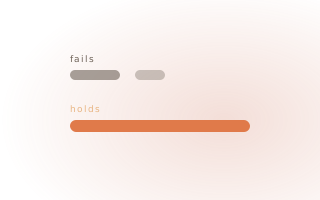
You already know how much time you want to spend on the apps that pull at you. Most people, asked on a calm afternoon, can name the number without hesitation. Thirty minutes of Instagram. An hour of YouTube. A little less than yesterday.
So why is it so hard to stick to?
The decision arrives at the worst possible moment
The usual screen-time tool works like this: you set a cap, you reach it, and a message appears. Time’s up. Want fifteen more minutes? There’s a button. You tap it.
Of course you tap it. The whole reason the cap exists is that the app is good at making you want one more minute — and the message arrives in the exact moment that want is loudest. The afternoon version of you set the rule. The evening version, tired and pulled, is the one asked to enforce it. That’s a fight the afternoon almost always loses.
This isn’t a failure of willpower. It’s a failure of timing. A rule that asks for a fresh decision at the moment of weakest resolve isn’t a rule at all. It’s a suggestion with a snooze button.
A budget is a decision you already made
Pausa starts from a different place. You don’t set a limit that nags — you set a daily budget, once, when you’re clear-headed. After that, the budget is simply how much there is. Not a target to hit. Not a wall to argue with. Just the amount you decided on, spent down through the day like any other budget.
When it’s gone, you meet a pause. No red alert, no count of how much you “wasted,” no lecture. A calm screen, and the quiet fact that this app is spent for today.
The difference is who’s in charge at the hard moment. With a limit, the tired evening you has to choose again, and loses. With a budget, the choice was already made — and the line holds without asking you to make it twice.
Friction, not punishment
Pausa won’t pretend you can never change your mind. You can raise a budget. You can open past a pause. But with strict mode on, loosening your own rule takes a minute you have to sit through first — a slow, deliberate minute, while tightening it stays instant.
A minute is nothing on a calm afternoon and almost everything in a moment of impulse. The urge that felt urgent rarely survives sixty unhurried seconds. By the time the minute is up, you usually find you didn’t need the extra time after all — and if you genuinely did, it’s still yours.
That’s the whole mechanic. Not surveillance, not shame, not a streak you’ll feel bad about breaking. Just a structure that’s a little slower than the impulse, so the version of you that set the rule is the version that gets to keep it.
The point isn’t less. It’s yours.
A budget that holds doesn’t make your choices for you. It protects the ones you’ve already made from being quietly overturned by an app built to overturn them.
Every app on your phone wants your attention. This is the one that gives it back — not by locking you out, but by making sure that when the day is over, the way you spent it was the way you meant to.
You decide. Not the apps.