What 8,000 kids and four years tell us about attention
A major Karolinska study followed children for four years. The ones who used more social media drifted toward distraction — and the direction of cause is the part worth sitting with.
There is a particular kind of study that’s hard to wave away: the kind that follows the same people for years, watches what changes, and rules out the easy objections one by one. Most screen-time headlines don’t come from studies like that. This one does.
In December 2025, researchers at Karolinska Institutet and Oregon Health & Science University published a four-year study in Pediatrics Open Science. They followed 8,324 children — average age nine when it began — tracking how much time they spent on social media, video, and games, while parents rated their attention year over year.
Two things stood out.
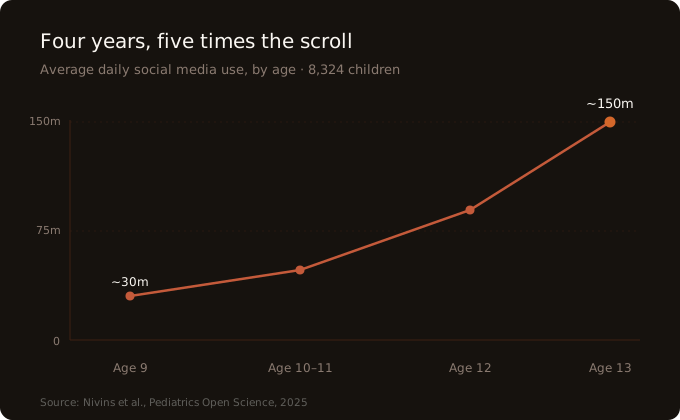
The first is how fast the habit grows. Among these children, average daily social media time climbed from about 30 minutes at age nine to 2.5 hours by thirteen — a fivefold rise in four years, much of it before the age most platforms even permit.
The second is what came with it. The children who used more social media drifted, gradually, toward more inattention — more difficulty sustaining focus over time. The effect for any single child was small. But the researchers were careful about something most coverage skips: the direction.
Which way the arrow points
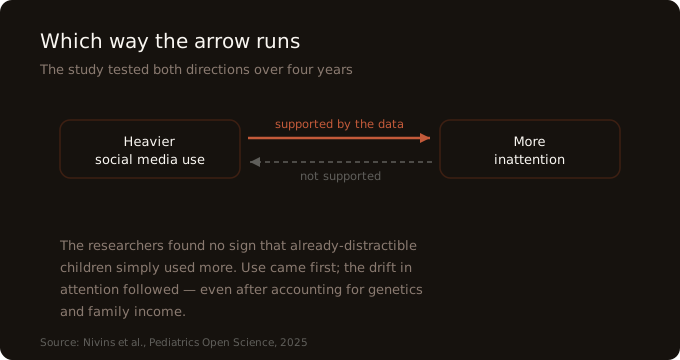
The obvious objection to any study like this is reverse causation. Maybe distractible kids simply gravitate to social media — the apps aren’t shaping attention, they’re just attracting the already-restless.
The researchers checked. They found no evidence that children with more inattention increased their social media use over time. The arrow ran the other way: heavier use came first, the drift in attention followed. They accounted for genetic predisposition to ADHD and for socioeconomic status, and the association held. They interpret it, cautiously, as a likely causal effect.
It’s worth being precise about the limits, because the researchers are. This is a study of children, not adults. The individual effect is modest. And they note something easy to miss: the type of use may matter more than the raw hours — endless fragmented scrolling is not the same as a long video call with a grandparent.
But the shape of the finding is hard to unsee. Attention isn’t fixed. It’s trained. And a feed built to be checked every forty seconds is training something.
What this has to do with you
You are not a nine-year-old, and Pausa is not built for children. So why does this study sit so close to what Pausa is about?
Because the mechanism doesn’t check your age at the door. The pull these children experienced — the gradual pricing-down of sustained attention by a stream designed to fragment it — is the same pull an adult feels at 11pm, three reels deep, having opened the app to do one thing. The study simply caught it in slow motion, in people whose habits were still forming, with the measurement rigor to say which way it runs.
The reassuring part is the same as the worrying part: if attention can be trained down, it can be trained back. Not through willpower in the tired moment — the study is practically a portrait of how unevenly that fight goes — but by deciding in advance how much of your day the feed gets, and holding that line when the pull arrives.
That’s the whole idea behind a daily budget. You set the number on a clear afternoon. The app keeps it for you in the moment you’d otherwise lose. The point was never to shame the scroll. It’s to keep the apps from quietly deciding how much of your attention they get — the way, for four years, they decided for eight thousand kids.
Source: Nivins S, Mooney MA, Nigg J, Klingberg T. “Digital Media, Genetics, and Risk for ADHD Symptoms in Children: A Longitudinal Study.” Pediatrics Open Science, 2025. doi:10.1542/pedsos.2025-000922